

ISO 14001:2026 – Key Changes and Transition Requirements for Certified Organisations
ISO 14001:2026 is a moderate revision rather than a complete rewrite.
However, it strengthens expectations around context analysis, including climate and wider environmental conditions such as biodiversity, along with risk and opportunity planning, management of change, and life-cycle thinking.
The revised wording and alignment with ISO’s Harmonized Structure aim to reinforce consistency, traceability, and environmental relevance across management system standards.
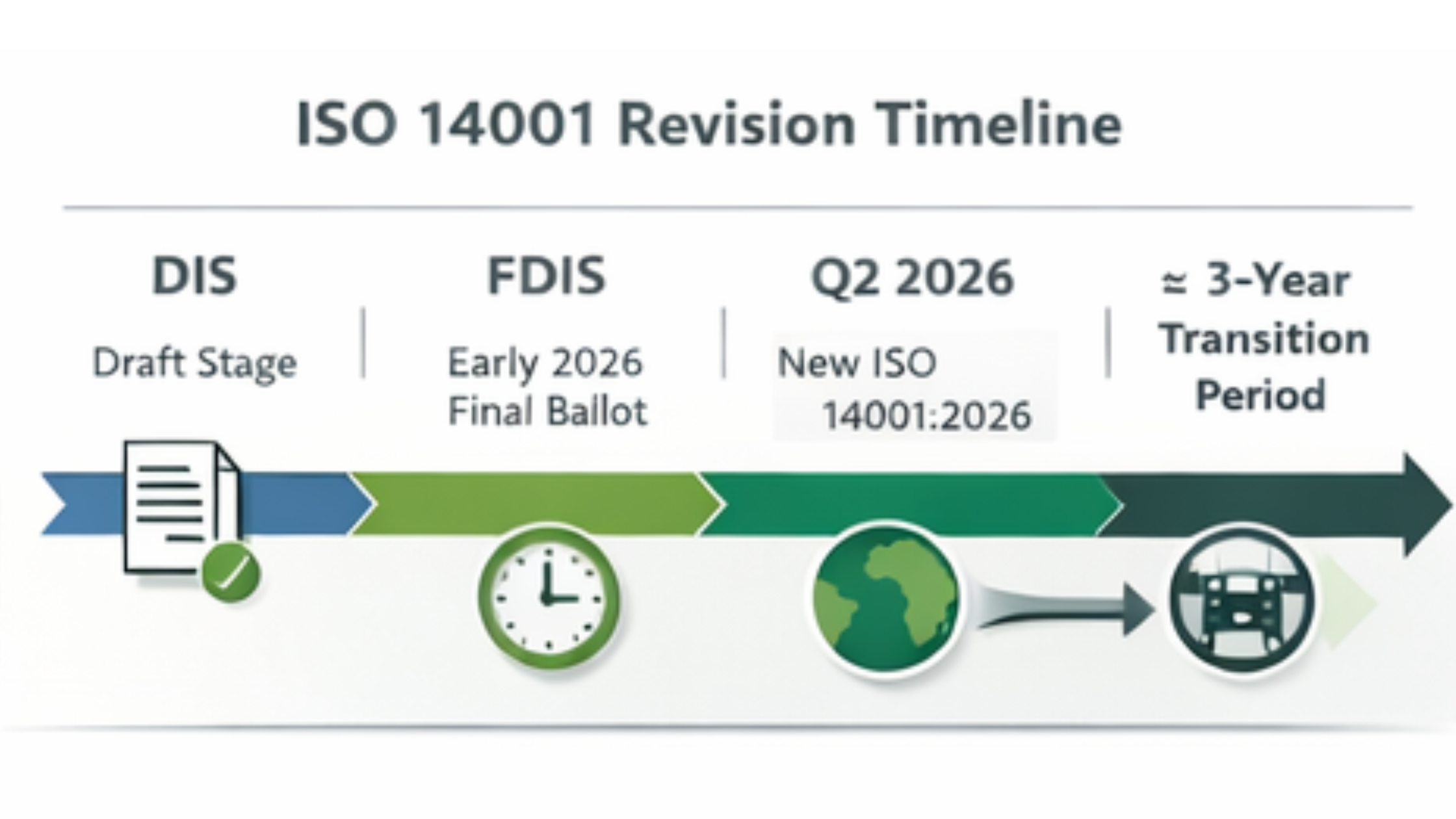
ISO indicates the revised edition is expected to be published in April 2026 and to replace ISO 14001:2015 following the defined transition period.
Where we are in the ISO 14001 revision cycle? Why does it matter?
As of early 2026, ISO 14001 has reached the Final Draft International Standard (FDIS) stage. This means the technical work is effectively complete and the standard is undergoing its final approval process by ISO national members. Barring unexpected objections, publication is expected around April 2026.
For organisations, this timing is not neutral. Once the revised standard is published, certification bodies will formally open the transition period, which is expected to last approximately three years, in line with usual IAF practice. While final transition deadlines are always confirmed after publication through IAF and accreditation body communications, experience shows that organisations that wait until the final year tend to face avoidable pressure: limited auditor availability, rushed gap closures, and poorly embedded changes.
From a best-practice perspective, the most effective transitions start early, during routine surveillance cycles, allowing changes to be absorbed naturally into the existing Environmental Management System rather than treated as a last-minute compliance exercise.
Note: Organisations certified to ISO 14001:2015 will be required to transition to ISO 14001:2026 within the defined transition period in order to maintain certification validity.
The part many organisations already missed: the 2024 climate amendment
Before even considering ISO 14001:2026, it is important to acknowledge that the standard has already evolved. In 2024, ISO and IAF issued a formal climate change amendment applicable to all major management system standards.
This amendment introduced explicit expectations in two foundational clauses. Organisations are now required to determine whether climate change is a relevant issue within their context, and to recognise that interested parties may have climate-related requirements.
What changed is not the requirement to “manage climate” as such, but the obligation to explicitly consider it and to justify conclusions. In practice, this has already influenced audits. Auditors are no longer satisfied with implicit assumptions or generic statements. They expect to see evidence that climate considerations were consciously analysed as part of the context and interested parties review, even when the organisation concludes that climate is not a significant issue for its activities.
The key lesson here is methodological: ISO 14001 increasingly rewards reasoned decisions supported by evidence, rather than silent assumptions. This logic carries directly into the 2026 revision.
What really changes in ISO 14001:2026 beyond the headlines?
ISO 14001:2026 is deliberately designed as a moderate revision. Organisations familiar with ISO 14001:2015 will recognise the structure, the core concepts, and the EMS logic. However, the revised text tightens expectations in areas that were previously open to superficial treatment.
A broader and more demanding understanding of “context”
The concept of context is not new, but the revised standard makes it harder to treat it as a generic environmental scan. Organisations are expected to consider a wider range of environmental conditions, extending beyond climate change to include elements such as pollution pressures, resource availability, water stress, land use, and biodiversity sensitivities.
From an audit perspective, the key shift is not about listing more issues, but about demonstrating relevance. Context must now visibly inform risk and opportunity identification, environmental objectives, and operational controls. A context analysis that exists in isolation, disconnected from planning and decision-making, will increasingly be challenged.
Best practice is to treat context as a living input to the EMS, not a static description updated only for audits.
Clearer expectations for risk and opportunity planning
Risk-based thinking has been part of ISO 14001 for years, but the 2026 revision clarifies how risks and opportunities are expected to flow through the system. The intent is to reinforce traceability between environmental aspects, compliance obligations, planning decisions, and operational control.
In practice, this does not require reinventing risk registers or creating complex tools. What auditors will look for is coherence: can the organisation clearly explain how identified risks and opportunities influence objectives, controls, monitoring, and improvement actions? Where this line of sight exists, even simple tools remain fully acceptable.
Planning of changes: from implicit to explicit
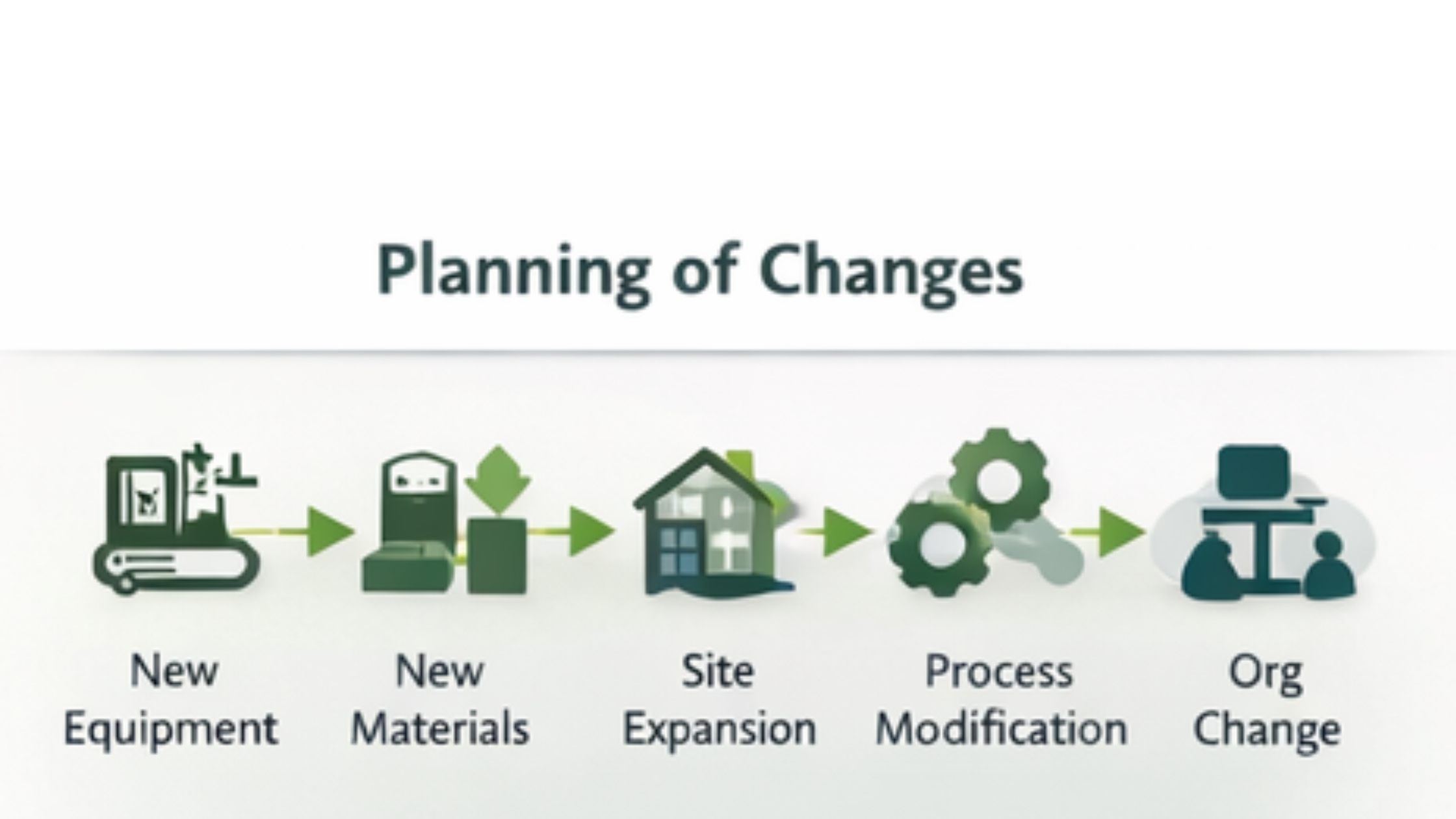
One of the most operationally significant clarifications in ISO 14001:2026 concerns the planning of changes. While change management was already implied in the standard, the revised wording makes expectations more explicit.
Organisations are now expected to demonstrate that environmentally relevant changes are planned in a structured way. This includes changes such as new equipment, new materials, process modifications, site expansions, supplier changes, or organisational restructuring.
The emphasis is not on bureaucracy, but on anticipation. Effective systems show that environmental aspects, compliance obligations, competence needs, and emergency preparedness are considered before changes are implemented, not retroactively during audits.
Reinforced life-cycle perspective
The life-cycle perspective, often reduced in practice to a brief statement, gains renewed importance in ISO 14001:2026. Organisations are expected to show that they have meaningfully considered upstream and downstream impacts where they have influence, particularly through procurement, design, logistics, and waste management decisions.
This reinforcement has practical consequences. Where life-cycle impacts are claimed to be insignificant, organisations should be able to explain why. Where influence exists, even limited, it should be reflected in purchasing criteria, specifications, or contractor controls. The standard continues to respect proportionality, but it expects conscious choices, not omissions.
Improved alignment with ISO’s Harmonized Structure
Finally, the revised edition aligns more closely with ISO’s current Harmonized Structure. For organisations operating integrated management systems, this improves consistency of language, structure, and expectations across ISO 9001, ISO 14001, ISO 45001, and related standards. While this change is largely editorial, it supports more coherent system integration and governance.
How already certified organisations should approach the transition
For organisations certified to ISO 14001:2015, the objective is not to rebuild the EMS, but to demonstrate alignment with clarified intent and to address the areas that were previously treated informally.
A robust transition typically begins with a structured delta analysis between the 2015 and 2026 editions, explicitly including the 2024 climate amendment. This step is critical: most transition difficulties arise not from new requirements, but from assumptions that “nothing really changed.”
From there, a focused gap assessment involving EMS owners, operational teams, procurement, maintenance, and compliance functions allows the organisation to test whether context, risk planning, life-cycle thinking, and change management are truly embedded in practice.
Documentation updates should be purposeful. ISO 14001:2026 does not reward documentation volume, but clarity. Procedures, methodologies, and records should be updated only where they support control, traceability, or decision-making.
Competence and awareness activities should be targeted. Short, role-based sessions explaining what has changed and why are far more effective than generic retraining.
Before the certification transition audit, an internal audit against the revised requirements is strongly recommended, followed by a management review that explicitly addresses the transition outputs. This approach allows the organisation to enter the certification body audit with confidence rather than defensiveness.
What actually works in audits: practical examples
In practice, auditors are reassured by simple, well-reasoned evidence. A concise context note explaining why climate and biodiversity are relevant or not for specific sites is far more effective than lengthy generic reports. A lightweight change planning workflow that has been demonstrably used on real projects carries more weight than a sophisticated procedure no one follows.
Similarly, modest procurement requirements addressing environmental criteria, packaging choices, or waste routes often provide sufficient evidence of life-cycle consideration when aligned with significant aspects.
Typical transition nonconformities and how to avoid them
The most common issues observed during transitions are not technical failures, but logical gaps. Climate considerations assumed but not documented, context analyses updated without corresponding changes to risk planning, informal change management practices with no traceable evidence, and life-cycle claims unsupported by operational controls all remain frequent sources of nonconformity.
These are avoidable when organisations focus on consistency and traceability, rather than formality.
Why this revision matters beyond certification
For organisations facing ESG questionnaires, supply-chain scrutiny, or CSRD-related expectations, the evolution of ISO 14001 is not isolated. The reinforced focus on context, interested parties, and life-cycle thinking strengthens the EMS as a credible governance backbone, capable of supporting sustainability claims with operational evidence.
Different frameworks, different objectives but increasingly, the same expectation: show how you know, not just what you say.
Practical transition quick wins (without overengineering the EMS)
For organisations already operating a mature ISO 14001 system, the transition to the 2026 edition does not require structural upheaval. In practice, a few targeted actions often deliver most of the compliance and audit readiness benefits.
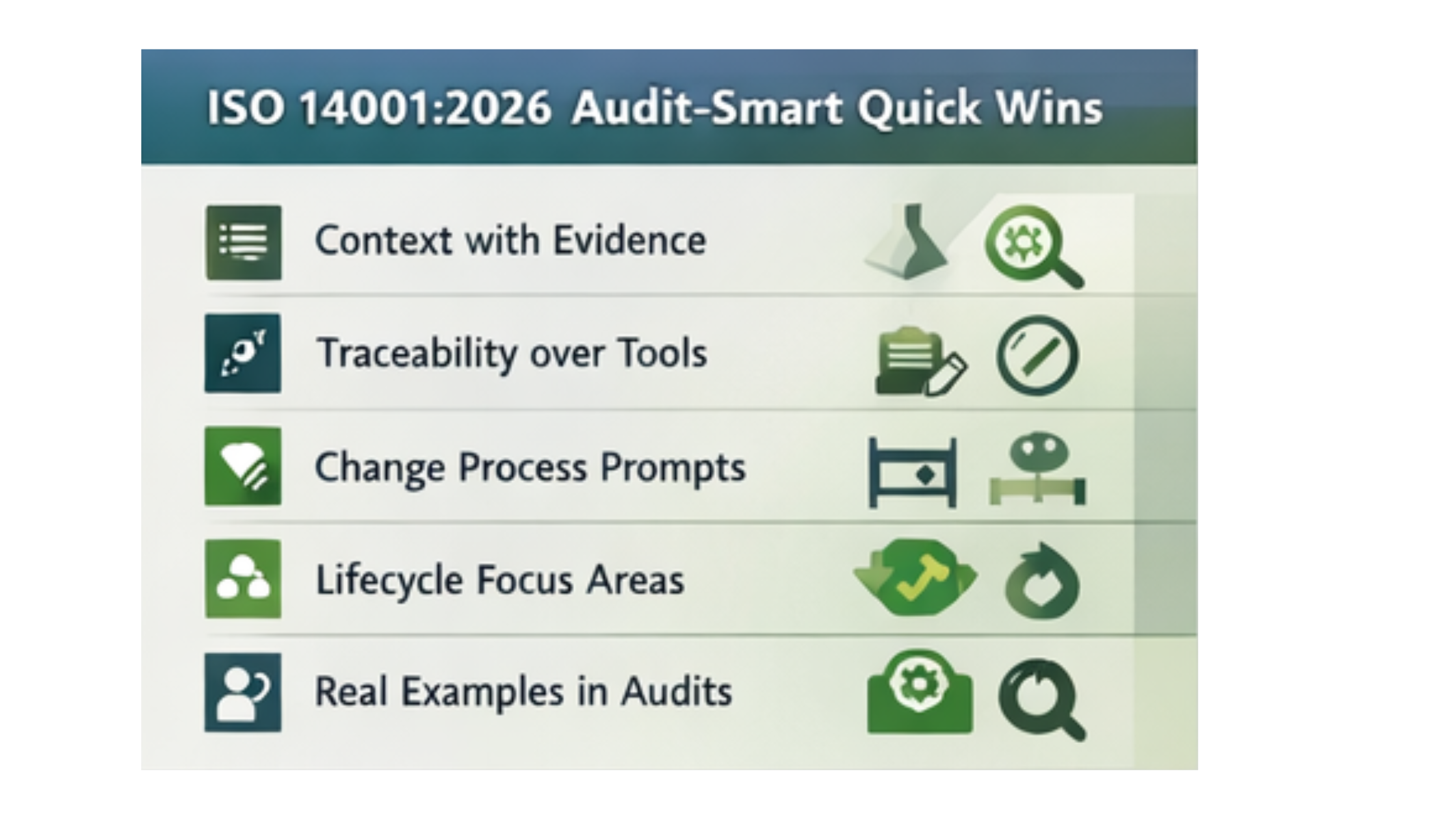
- Revisit the context analysis with intention, not length
A short but well-reasoned update to the context review is often sufficient. Explicitly addressing climate-related factors and broader environmental conditions such as resource constraints or local biodiversity sensitivities demonstrates awareness and control. What matters is not how many issues are listed, but how clearly relevance is justified. - Strengthen traceability rather than creating new tools
Before introducing new registers or templates, check whether existing risk and opportunity assessments clearly link environmental aspects, compliance obligations, objectives, and controls. In many cases, minor adjustments to explanations or cross-references provide the clarity auditors expect. - Formalise change planning using existing workflows
Most organisations already manage change operationally. The quick win is to integrate environmental prompts into existing change processes rather than creating a separate EMS procedure. Showing that environmental impacts and compliance implications are considered before changes are implemented is often enough. - Make life-cycle thinking visible where influence exists
Life-cycle consideration does not mean analysing everything. Focus on areas where the organisation has real influence—procurement specifications, contractor selection, packaging, or waste treatment. Small, documented decisions in these areas often provide strong audit evidence. - Use real examples during internal audits and management review
Auditors respond well to concrete cases. Reviewing one or two recent changes, procurement decisions, or environmental incidents through the lens of the revised requirements helps demonstrate that the EMS is alive, not theoretical.
ISO 14001:2026 as a bridge between management systems and sustainability reporting
The 2026 revision of ISO 14001 confirms a broader trend rather than introducing a disruption. Environmental management systems are no longer assessed solely on procedural completeness, but on their ability to anticipate change, understand context, and demonstrate credible control over impacts across the value chain.
This evolution closely mirrors expectations emerging from sustainability reporting frameworks and ESG disclosure requirements. While ISO 14001 and sustainability reporting serve different purposes, they increasingly rely on the same foundations: structured governance, documented decision-making, stakeholder awareness, and traceable evidence.
Organisations that approach ISO 14001:2026 as a compliance update may meet certification requirements. Those that use it to reinforce the logic, coherence, and credibility of their environmental management system will also find themselves better prepared to respond to sustainability reporting demands whether driven by regulators, customers, investors, or supply-chain partners.
In that sense, ISO 14001:2026 is not just an updated standard. It is a strategic opportunity to align operational environmental control with the wider sustainability narrative, using a framework that auditors, regulators, and stakeholders already trust.
Article publié par Eco Fluent Solutions – expertise en systèmes de management ISO et gouvernance de la durabilité.
Besoin de clarifier votre transition ISO 14001:2026 ou d’évaluer votre niveau de préparation ?
J’accompagne les PME dans la transformation des exigences ISO et ESG en systèmes opérationnels, sans sur-documentation ni usine à gaz.