
By Dr Souha Bel Haj Messaoud | Founder, Eco Fluent Solutions | Updated: July 2026 | Reading time: 12 min
You received an email from EcoVadis asking you to complete a questionnaire. Maybe it is the first time. Maybe you have already filled it in once, without really knowing whether you answered well. Maybe your score came back and it is lower than you hoped.
In all cases, you are not alone. Thousands of French SMEs receive an EcoVadis invitation each year from a major corporate client, and most do not really know where to start.
This guide is for you. It explains how EcoVadis works, what the score actually measures, why some well-run SMEs get disappointing scores, and how to concretely improve your responses.
No unnecessary jargon. No vague promises. Just what you need to know to approach EcoVadis methodically.
What is EcoVadis?
EcoVadis is a platform for assessing the CSR (Corporate Social Responsibility) performance of supplier companies. It was created in 2007 and is now used by more than 100,000 companies worldwide.
Its operation is simple in principle: a major corporate client, subject to CSR reporting obligations across its value chain, commissions EcoVadis to assess its suppliers. You receive an invitation to complete an online questionnaire. EcoVadis analyses your responses and the documents you submit, then assigns a score to your company.
This score is then visible to your client. It can condition your retention in their supplier panel, your access to new tenders, or simply the perceived quality of your commercial relationship.
Important point to understand:
EcoVadis is not a legal obligation for SMEs. You do not report directly under the CSRD (Corporate Sustainability Reporting Directive, the European directive on sustainability reporting for large companies). But your major corporate client is subject to requirements on its value chain. That is what generates the indirect pressure you feel.
Does your EcoVadis score not reflect what you actually do? Read this: [ EcoVadis for SMEs — why your score doesn’t match your reality and how to fix it]
How does the EcoVadis score work?
The EcoVadis score is a rating out of 100 points, calculated from your questionnaire responses and the supporting documents you provide.
The 4 themes assessed
EcoVadis assesses your CSR performance across four themes:
1. Environment Management of greenhouse gas (GHG) emissions, energy consumption, water, waste, biodiversity management, and the environmental impact of your products or services.
2. Social and Human Rights Working conditions, occupational health and safety, social dialogue, non-discrimination, child labour, forced labour, fundamental workers’ rights.
3. Ethics Fight against corruption and anti-competitive practices, personal data protection, reporting of unethical behaviour.
4. Responsible Purchasing Integration of CSR criteria into your own purchasing and supplier management — in other words, into your own supply chain.
Theme weighting
The four themes are not weighted identically for all companies. EcoVadis adapts weighting according to your sector of activity and company size.
For an industrial SME, the Environment theme will generally carry more weight than for a services SME. For a distribution company, Responsible Purchasing will be more heavily weighted.
What this means in practice: before starting to improve your dossier, identify which themes weigh most in your sector. Focus your effort where the impact on your score will be strongest.
Medal levels
The final score leads to the award of a medal:
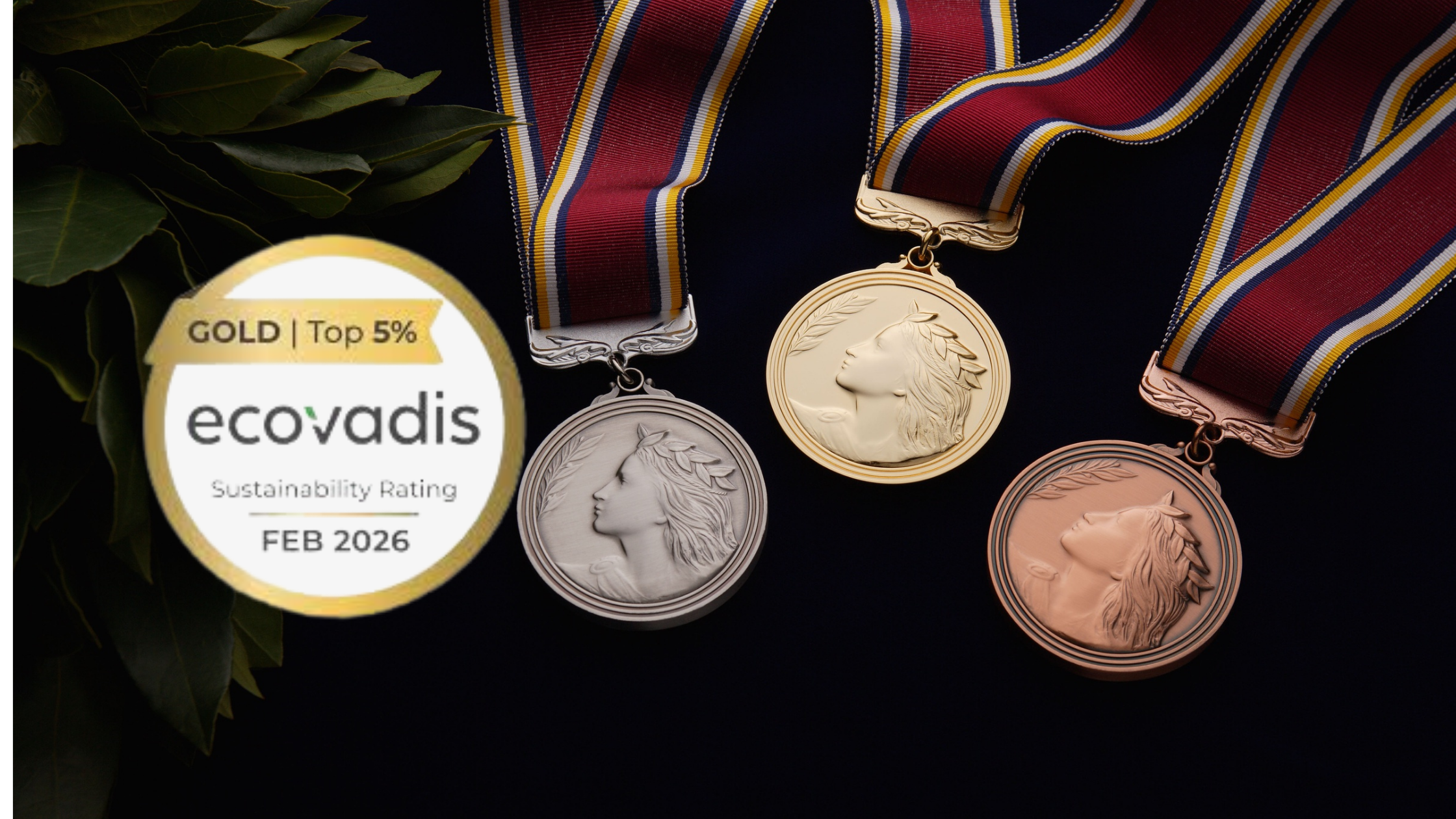
- Platinum Medal: score ≥ 78 — top 1% of assessed companies
- Gold Medal: score ≥ 62 — top 5%
- Silver Medal: score ≥ 45 — top 25%
- Bronze Medal: score ≥ 25 — top 50%
Most major corporate clients require their suppliers to achieve at least a Bronze or Silver medal. Aiming for Gold on the first assessment is ambitious, but achievable with serious preparation.
What EcoVadis actually assesses — and what many SMEs miss
This is the most important point in this guide, and the one most SMEs underestimate.
EcoVadis does not assess what you do. EcoVadis assesses what you can prove.
An SME that has implemented a waste sorting policy, trains its teams on safety and selects suppliers on CSR criteria will get a disappointing score if it cannot provide documentary evidence.
Conversely, an SME that does not yet have a very advanced CSR approach but has correctly documented its existing practices will get a better score.
EcoVadis assesses three levels for each theme:
- Policies: have you formalised written commitments (environmental policy, code of conduct, supplier charter…)?
- Actions: have you implemented concrete measures (plans, programmes, certifications, training…)?
- Results: do you have measurable indicators that prove the impact of your actions?
The vast majority of SMEs have actions. Many do not have written policies. Almost none track results indicators. That is where the score is lost.
To understand how to structure your CSR information sustainably: [VSME: the simplified ESG standard for SMEs]
How to improve your responses: a practical step-by-step guide
Step 1: Gather your evidence before you start answering
Do not start filling in the questionnaire without first gathering your documents. Once the questionnaire is open, you have a limited time to complete it. Working without preparation leads to incomplete responses.
Make a list of documents you can produce immediately:
- Environmental policy or CSR charter (even one page)
- Single Document for Risk Assessment (DUER) — mandatory for all companies in France
- Energy consumption report or bills allowing reconstruction
- Internal training register
- Code of conduct or ethics charter
- General purchasing conditions with CSR clauses
- Existing certifications: ISO 14001 (environment), ISO 45001 (health and safety), ISO 50001 (energy), sector labels
If some of these documents do not yet exist in formalised form, a week of targeted work can produce several. Do not underestimate what your company already does. The problem is often lack of formalisation, not lack of practices.
Step 2: Answer with evidence, not declarations
For each question, EcoVadis asks you to answer Yes / Partially / No, and requests supporting documents.
Never answer “Yes” without a document. EcoVadis has a team of analysts who verify consistency between your responses and the evidence provided. A “Yes” without supporting documentation is either ignored or scored negatively as inconsistent.
Answer “Partially” honestly. A well-documented “Partially” answer is worth more than a “Yes” without proof. EcoVadis analysts value consistency and progress.
Attach recent documents. Documents more than two years old are generally given little weight. Prefer documents from the current or previous year.
Step 3: Focus on high-impact themes in your sector
As noted above, weighting varies by sector. Before working uniformly across all four themes, identify the two most heavily weighted themes for your activity.
For an industrial SME: Environment and Social / Human Rights are generally priorities. For a services SME: Social / Human Rights and Ethics carry more weight. For a distribution or trading SME: Responsible Purchasing is a critical theme.
Devote 60% of your preparation effort to the two dominant themes. Score gains will be most significant there.
Step 4: Check overall dossier consistency before submitting
Before submitting your questionnaire, review all your responses and documents asking one question: is everything consistent?
If you declare an environmental policy but do not provide the document, that is an inconsistency. If you declare training your teams on safety but cannot provide a training register, that is an inconsistency. If you declare assessing suppliers on CSR criteria but have no clause in your purchasing conditions, that is an inconsistency.
EcoVadis analysts systematically look for these inconsistencies. An identified inconsistency does not just cost one point — it can call several positive responses into question.
The most common mistakes that lower the EcoVadis score
Filling in the questionnaire in a single session without preparation.
The EcoVadis questionnaire is long and detailed. Completing it in one go, without having gathered documents beforehand, invariably produces incomplete or inconsistent responses.
Confusing “existing practice” with “documented practice”.
Your company very probably has good CSR practices. But if they are not written down, EcoVadis cannot value them. Minimal formalisation — one written page, a simple procedure — makes a considerable difference to the score.
Ignoring the Responsible Purchasing theme.
This theme is often neglected by SMEs who think it does not concern them. Yet including a few CSR clauses in your general purchasing conditions and being able to cite two or three supplier selection criteria can generate several additional points.
Submitting generic, non-customised documents.
An environmental policy template downloaded from the internet and signed without adaptation to your activity is generally given little weight. EcoVadis assesses the relevance and adaptation of documents to your specific context.
Not taking advantage of the correction period.
EcoVadis generally allows a review period after submission. Many SMEs do not know this and miss the opportunity. Check the available deadlines in your interface before submitting definitively.
How long does it take to improve your EcoVadis score?
There is no universal answer, but here are realistic orders of magnitude.
For a first assessment with little existing documentation: allow 4 to 6 weeks of serious preparation to gather and formalise essential elements. Aiming for Bronze or Silver is realistic in this timeframe.
For a reassessment after a disappointing first score: the most significant improvements are built over 3 to 6 months — the time to formalise policies, implement measurable actions and document initial results.
To progress towards Gold: it generally takes two assessment cycles, approximately 18 to 24 months, with a structured CSR approach and tracking indicators in place.
The good news: the effort you make for EcoVadis does not serve EcoVadis alone. A formalised environmental policy, energy consumption tracking, a supplier charter — these are management tools with value beyond the questionnaire.
Frequently asked questions about EcoVadis for SMEs
Is it mandatory to respond to EcoVadis?
No, it is not a legal obligation. But refusing to respond can have commercial consequences: your client may decide to remove you from their supplier panel or assign you a high risk rating. In a context where major corporations are strengthening CSR requirements across their value chain, ignoring EcoVadis is becoming increasingly costly commercially.
How much does EcoVadis cost for an SME supplier?
For a supplier invited by a client, the EcoVadis assessment is generally paid — the cost is borne by the supplier, unless otherwise agreed with the client. Rates vary according to company size and assessment validity period. Check directly with EcoVadis or your client on the terms applicable to your situation.
Who can see my EcoVadis score?
Your score is visible to clients who commissioned an assessment. EcoVadis does not share your score with other companies without your consent. However, you can choose to make your score visible to other potential buyers via the platform — which can be a commercial advantage if your score is high.
We have no formal CSR policy. Where do we start?
Start with what you already have. All companies have informal CSR practices: waste sorting, safety training, supplier relationships, ethical behaviour. The challenge is to formalise them in writing. Three basic documents — a one-page environmental policy, a code of conduct and purchasing conditions with a CSR mention — can make an immediate difference to your score.
Are EcoVadis and VSME the same thing?
No. EcoVadis is a CSR assessment platform used by major corporations to rate their suppliers. VSME (Voluntary SME Standard — voluntary ESG reporting standard for SMEs) is a reporting framework that SMEs can use to structure and communicate their sustainability data. The two are complementary: VSME can help you structure your CSR information in a way that effectively feeds an EcoVadis questionnaire or any other client questionnaire.
Can a consultant fill in the EcoVadis questionnaire on our behalf?
A consultant can support you in preparing your dossier, formalising your policies and organising your evidence. But responses must reflect your company’s reality — EcoVadis verifies consistency and may request clarifications. External support helps you value what you actually do, not to declare what you do not do.
Ready to improve your EcoVadis score?
Receiving an EcoVadis questionnaire without preparation is stressful. With the right method, it is an opportunity to value what your company already does and identify the few priority actions that will really make a difference.
At Eco Fluent Solutions, I support SMEs in structuring their CSR data and preparing responses to client questionnaires — EcoVadis, CSRD value chain questionnaires, and other supplier assessments.
→ Access Digital Solutions — training and practical resources to structure your CSR approach and respond effectively to client requirements.
→ Download the free CSR checklist: the 20 pieces of information to have before any client questionnaire.
Related articles:
- ESG Questionnaires: Why SMEs Can No Longer Keep Up
- VSME: the simplified ESG standard for SMEs
- The VSME is not just another report: a management tool for SME leaders
Dr Souha Bel Haj Messaoud is the founder of Eco Fluent Solutions, a Paris-based consultancy specialising in ISO management systems, CSR governance and ESG compliance. She supports French and European SMEs in structuring their sustainability data and responding to CSR requirements from major corporate clients. Learn · Comply · Lead — ecofluentsolutions.com