
ISO 14001:2026 is a moderate revision rather than a complete rewrite.
However, it strengthens expectations around context analysis — including climate and broader environmental conditions such as biodiversity — as well as planning for risks and opportunities, change management and life-cycle thinking.
The revised wording and alignment with the harmonised ISO structure aim to strengthen coherence, traceability and environmental relevance across management systems.
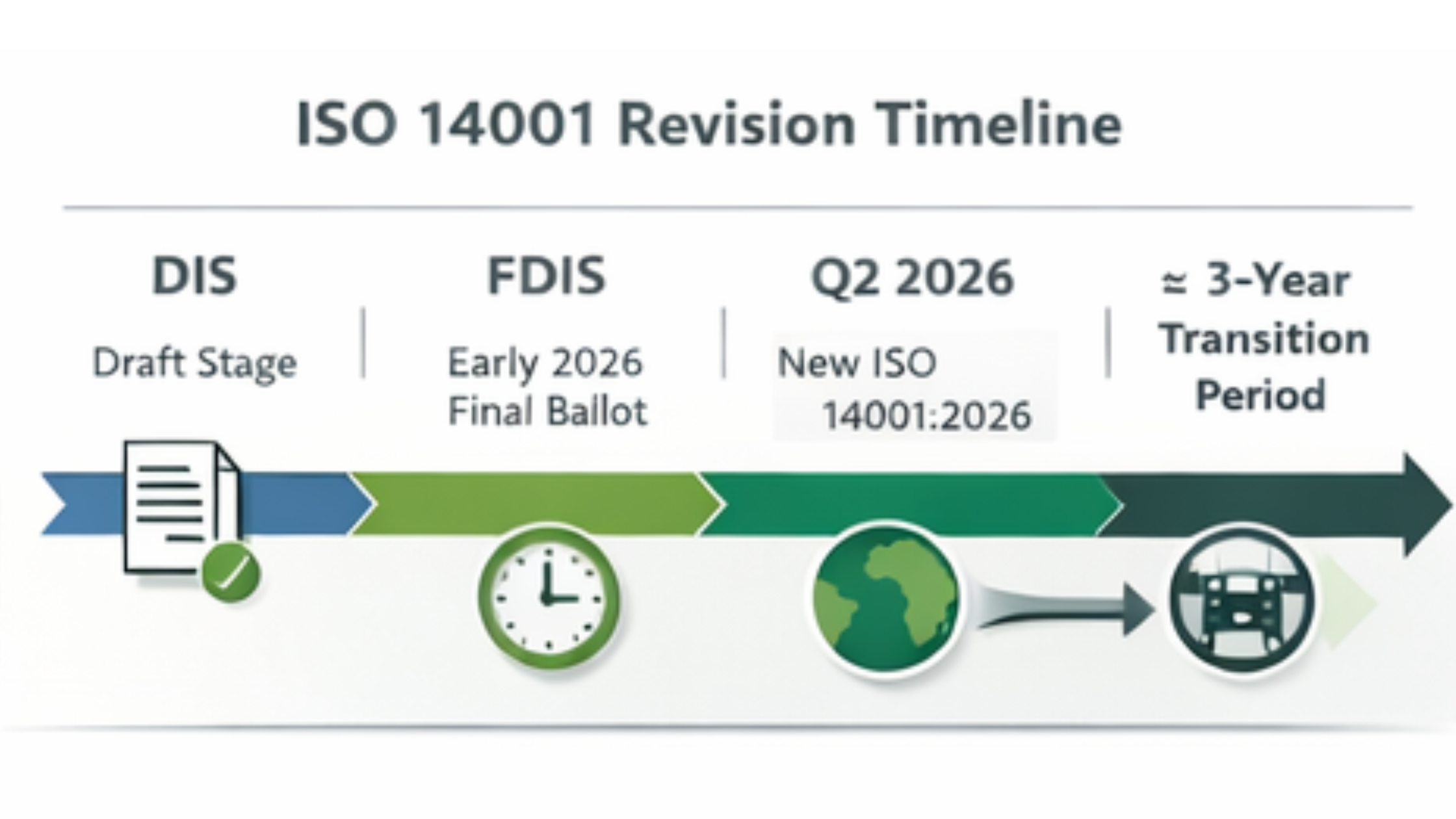
ISO indicates that the revised edition should be published in April 2026 and replace ISO 14001:2015 after the defined transition period.
Where are we in the ISO 14001 revision cycle? Why it matters
In early 2026, ISO 14001 reached the FDIS (Final Draft International Standard) stage. The technical work is effectively complete; the standard is undergoing final approval by ISO national members. Barring an unexpected objection, publication is expected around April 2026.
For organisations, this timeline is not neutral. Once the standard is published, certification bodies will formally open the transition period, of approximately three years according to usual IAF practices. Organisations that wait until the final year often face avoidable pressure: limited auditor availability, rushed gap closures and poorly embedded changes.
The most effective transitions start early, during routine surveillance cycles, to integrate the changes naturally into the EMS rather than as a last-minute compliance exercise.
Note: organisations certified to ISO 14001:2015 will need to transition to ISO 14001:2026 within the defined timeframe to maintain the validity of their certification.
What many have already missed: the 2024 climate amendment
Even before ISO 14001:2026, the standard has already evolved. In 2024, ISO and the IAF published a formal climate amendment applicable to major management systems.
This amendment introduces explicit expectations in two fundamental clauses: determining whether climate change is a relevant issue in the organisation’s context, and recognising that interested parties may have climate-related requirements.
What changes is not the obligation to “manage climate” as such, but the obligation to consider it explicitly and to justify conclusions. In practice, this already influences audits: auditors expect evidence that climate has been consciously analysed within the context and interested parties framework, even when the organisation concludes it is not a major issue.
What really changes in ISO 14001:2026
A broader, more demanding understanding of “context”
Context is no longer limited to the immediate regulatory environment. Climate, biodiversity, water stress, circularity and evolving environmental conditions must be examined in a structured, documented way.
Clearer expectations for risks and opportunities
Planning must link environmental issues, risks, opportunities and EMS actions — with traceability the auditor can follow from diagnosis to action.
Change planning: from implicit to explicit
Significant EMS changes (processes, scope, technologies) must be anticipated, assessed and controlled — not just managed after the fact.
Strengthened life-cycle perspective
The organisation must consider environmental impacts across the life cycle where relevant — sourcing, use, end of life — and integrate this logic into its objectives and indicators.
Better alignment with the harmonised ISO structure
Coherence with ISO 9001, ISO 45001 and other management systems facilitates integrated audits and dialogue with stakeholders on sustainability in the broad sense.
How to approach the transition when already certified
- Gap analysis — compare current EMS vs 2026 requirements (and 2024 climate amendment).
- Prioritise high-impact audit clauses — context, risks/opportunities, changes, life cycle.
- Update evidence and records — not just procedures.
- Train teams and internal auditors on the new expectations.
- Plan the transition with your certification body as soon as official publication.
What works in audit: practical examples
- Context register including a “climate” line with documented justification.
- Risks/opportunities matrix linked to environmental objectives and action programmes.
- Change management procedure applied to a real project (new site, critical new supplier).
- Simplified but traceable life-cycle analysis for a key product or service.
Typical transition nonconformities — and how to avoid them
- Generic climate statements without analysis or justification.
- Updated procedures but unchanged field practices.
- Risks listed with no link to real environmental issues.
- No evidence of life-cycle consideration.
Why this revision goes beyond certification
ISO 14001:2026 brings the environmental EMS closer to CSRD, VSME and supply chain expectations: broader context, traceable data, change governance. A robust EMS makes it easier to answer client questionnaires and prepare for sustainability reporting.
Transition quick wins (without over-engineering)
- Complete the context and interested parties register (climate included).
- Link a priority environmental risk to a measurable objective.
- Document a recent change decision according to the new logic.
ISO 14001:2026 as a bridge between management systems and sustainability reporting
Organisations already using ISO 9001 / 14001 / 45001 have a foundation for structuring data, controls and continual improvement — assets directly reusable for ESRS and VSME. The 2026 transition is an opportunity to align environment, quality and sustainability around a single narrative.
SMEs and sustainability reporting: explore our SME ESG questionnaires or contact us.