
In brief: Most SMEs that receive a poor EcoVadis score are not lacking good CSR practices. They lack documentation. Before filling in the questionnaire, you first need to structure evidence of what you already do. This article explains why and how.
What is EcoVadis and why is your SME affected?
EcoVadis is the world’s most widely used CSR assessment platform in supply chains. It rates companies from 0 to 100 on four themes: environment, social, ethics, and responsible purchasing. It awards medals (Bronze, Silver, Gold, Platinum) to companies that exceed 50 points.
In 2025, more than 130,000 companies in 180 countries have an EcoVadis score. More than 1,400 major buyers rely on this rating to select their suppliers. Some have set a minimum score below which a supplier is excluded.
If you have received an EcoVadis invitation, it means your client considers you a strategic or priority partner. That is good news. What follows will tell you how not to waste this opportunity.
Why do SMEs often receive a score that doesn’t reflect their reality?
It starts with an email.
A client asks you to complete an EcoVadis assessment. The deadline is two to four weeks. The platform opens onto a structured questionnaire. And the pressure sets in.
The natural reaction is to log in, answer as best you can, and submit quickly.
That is precisely where the trap closes.
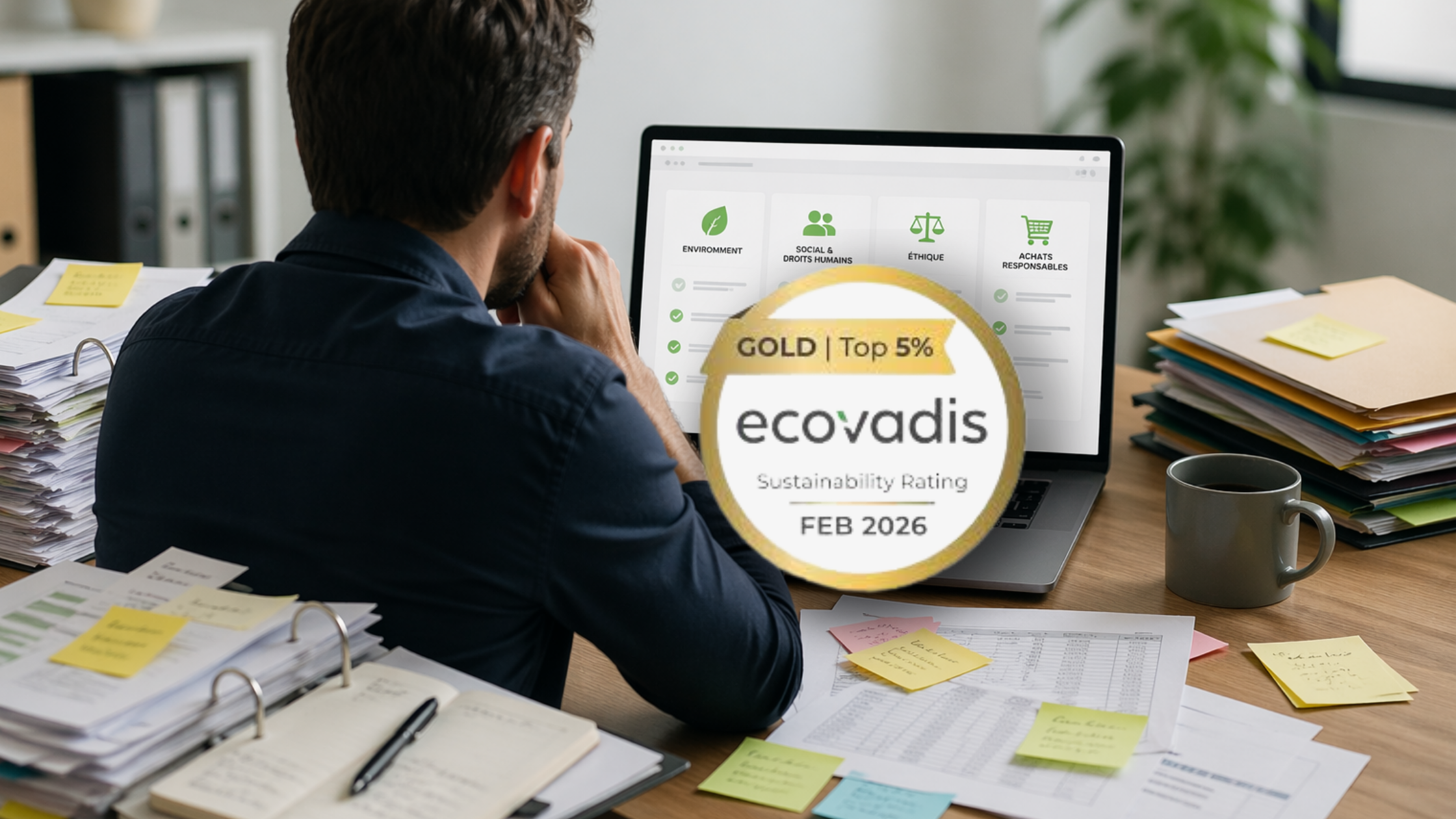
EcoVadis does not assess what you do. It assesses what you can prove.
For each criterion, the platform analyses three levels:
- Policies: a written commitment, signed and dated. Example: environmental charter, code of conduct.
- Actions: concrete measures implemented. Example: safety training, waste sorting.
- Results: measurable indicators. Example: energy consumption in kWh, accident rate.
If you cannot upload supporting documentation for each level, you lose points even if your company’s reality is solid.
What EcoVadis scoring rules do you absolutely need to know?
Two rules that most SMEs discover too late:
Rule 1: The minimum threshold per theme. A company cannot obtain a medal if its score is below 30/100 in any of the four themes, regardless of its overall score.
Rule 2: The medal threshold. Below 50/100 on the overall score, no medal is awarded. An “engaged company” badge is possible between 45 and 50, and a “rapid improvement” badge between 34 and 44 points with a 6-point progression.
This means an SME that performs well on the environment but forgets to document its ethical practices can end up without a medal even if its overall practices are sound.
Who receives EcoVadis assessments in France?
The figures are clear: in France, more than 70% of micro, small and medium suppliers are regularly asked by their clients about CSR topics.
In 79% of cases, this request comes at the tender stage — in other words, at the worst moment, when a contract is at stake and time is short.
And yet, 87% of suppliers receive no support from their clients to respond to these requests. 60% of affected companies have no person dedicated to CSR questions.
The result is predictable: questionnaire completed in a rush, approximate answers, no solid documentary evidence, and a score that does not match the company’s reality.
What are the concrete consequences of a poor EcoVadis score?
A low score on a first assessment does not necessarily exclude a supplier in the short term. But the consequences accumulate silently:
- Your score is visible to all buyers using EcoVadis, not only the client who requested the assessment.
- An insufficient rating can remove you from qualified supplier lists at renewal time.
- In a competitive tender, the EcoVadis rating becomes a tie-breaker criterion.
- The score is reassessed on an annual cycle: a poor rating is not corrected quickly.
Note: the EcoVadis Basic subscription for a micro-enterprise with fewer than 25 employees is €449 per year in 2026. This cost is marginal compared to the commercial value of a good rating.
How to prepare your EcoVadis assessment concretely?
The logic is simple: before opening the questionnaire, inventory what you already do and document what is not yet documented.
Here is what that means theme by theme.
Environment
- Consolidate your energy bills over 12 to 24 months (electricity, gas, fuel) in a simple spreadsheet.
- Check for an environmental policy or charter: even one page, but signed and dated.
- List reduction actions already in place: LED lighting, selective sorting, travel optimisation.
Social and Human Rights
- Gather your HR indicators: workplace accident rate, training hours per employee, turnover.
- Check that your internal regulations include clauses on harassment and non-discrimination.
- Document your existing health and safety procedures.
Ethics
- Check for a code of conduct or ethics charter: one page is enough if it is formalised.
- Identify your procedures for managing conflicts of interest and preventing corruption.
Responsible Purchasing
- Formalise your supplier selection criteria: even three simple criteria written down.
- Check whether you already ask CSR questions of your strategic suppliers, and document it.
The objective is not to invent practices. It is to make visible and document those that already exist.
Why do the best EcoVadis scores go to the most organised companies, not the most virtuous?
Companies that achieve the best EcoVadis scores have in common a system for tracking their indicators, often aligned with ISO 14001 or ISO 9001.
This is no coincidence. These are companies that did not wait for the EcoVadis invitation to structure their information. When the questionnaire arrives, the documents already exist.
For SMEs without this system, the solution is not to build everything in two weeks. It is to build a minimal ESG documentation kit, aligned with the four EcoVadis themes, once, in a structured way, reusable for all future requests.
This kit is not a sustainability report. It is not a company transformation. It is a structured response to a real request, with coherent and defensible evidence.
The difference between an SME that earns an EcoVadis medal and one that does not is often not a question of practices. It is a question of information organisation.
How Eco Fluent Solutions supports SMEs on EcoVadis
I support SMEs in preparing their EcoVadis assessment in three steps:
- Quick diagnosis: theme-by-theme identification of what already exists in your company.
- Document structuring: formatting and formalisation of existing elements.
- Questionnaire response: building answers with associated evidence.
The objective is not to produce complex reporting. It is to enable you to respond to EcoVadis and future questionnaires with structured, coherent and defensible information.
If your company has received an EcoVadis invitation or you anticipate receiving one soon, book an exploratory call to assess your situation.
Frequently asked questions about EcoVadis for SMEs
What is EcoVadis and what is the EcoVadis score used for?
EcoVadis is a global CSR assessment platform that assigns a score from 0 to 100 to companies on four themes: environment, social and human rights, ethics, and responsible purchasing. The score is used by major buyers to assess the CSR maturity of their suppliers and make purchasing or qualification decisions.
Is an SME required to respond to EcoVadis?
No. EcoVadis is a voluntary process in most cases. But if a strategic client sends you an invitation, refusing or obtaining a very low score can have direct commercial consequences: exclusion from tenders, disqualification as a supplier, loss of contracts.
What score is needed to obtain an EcoVadis medal?
You must exceed 50/100 on the overall score AND obtain at least 30/100 in each of the four themes. Medals are awarded from 50 (Bronze), then at higher levels for Silver (65+), Gold (73+) and Platinum (88+).
How long does it take to prepare an EcoVadis assessment?
Serious preparation generally takes between 2 and 6 weeks depending on the state of your existing documentation. Completing the questionnaire without preparation in a few days is possible but almost always produces a score that underestimates the company’s actual practices.
What documents must be provided for an EcoVadis assessment?
EcoVadis requests documentary evidence for each answer: formalised policies (environmental charter, code of conduct), numerical data (energy consumption, HR indicators), and proof of concrete actions (training records, internal procedures). The quality and relevance of supporting documents weigh as much as the questionnaire answers.
My SME already makes CSR efforts but has a poor EcoVadis score. Why?
This is the most frequent case. EcoVadis assesses your ability to demonstrate your practices, not just to claim them. If your actions are not formalised in accessible, dated documents, they are not counted even if they are real. The solution is to document what exists, not to create new practices.
About the author
Souha Bel Haj Messaoud is founder of Eco Fluent Solutions, a consultancy specialising in ESG governance and sustainability management systems for SMEs. She supports leaders in structuring credible, auditable and reusable ESG information, without unnecessary complexity.
Eco Fluent Solutions: Sustainability credibility is built, not declared.
Eco Fluent Solutions is a consultancy specialising in ISO management systems and sustainability governance. We support SMEs in turning ISO and ESG requirements into operational systems, without over-documentation or unnecessary complexity.
SME support: discover how to structure your responses to ESG and VSME questionnaires.