


A French SME looking for information on the VSME today may feel that the rules are changing faster than the guidance documents.
In 2025, the focus was on the VSME developed by the European Financial Reporting Advisory Group (EFRAG) and recommended by the European Commission.
In 2026, the European framework evolved again: the Omnibus Directive amended the sustainability reporting landscape, a new voluntary standard was adopted, the value-chain cap was formalised in EU law, and France’s Portail RSE now refers to the framework as “VS (ex-VSME)”.
So does the VSME still exist? Is the new standard mandatory? Does France need to transpose it into national law? And, most importantly, what should a French SME actually do in 2027?
In short
The VSME recommended in 2025 did not simply disappear. It became the basis for the new Voluntary Sustainability Reporting Standard, also referred to as the Voluntary Standard (VS), established by Commission Delegated Regulation (EU) 2026/1560 of 3 July 2026, published in the Official Journal of the European Union on 21 September 2026. The standard remains voluntary.
In France, two separate legal layers must be distinguished. Directive (EU) 2026/470 must be transposed into French law, mainly by 19 March 2027. By contrast, the EU Regulation establishing the VS is directly applicable and does not require French transposition.
For French SMEs, this is already practical rather than theoretical: Portail RSE allows companies to work with the VS (ex-VSME) in French, complete the framework online and generate a report.
5 key takeaways
- The 2025 VSME became the foundation of the new European Voluntary Standard.
- The standard remains voluntary for eligible undertakings.
- The value-chain cap applies for financial years beginning on or after 1 January 2027.
- France must transpose certain amendments introduced by the Omnibus Directive, but not the Regulation establishing the VS.
- French SMEs can already use Portail RSE to work with the VS (ex-VSME) in a French-language environment.
Was the VSME replaced in 2026?
Yes, the legal framework has evolved, but the new Voluntary Standard is directly built on the previous VSME framework.
In July 2025, the European Commission recommended a voluntary sustainability reporting standard for small and medium-sized enterprises based on EFRAG’s work.
That framework was widely known as the VSME — Voluntary Sustainability Reporting Standard for non-listed SMEs.
The 2026 reform moved the framework one step further.
Commission Delegated Regulation (EU) 2026/1560 explicitly states that the new voluntary standard is based on the standard adopted through the 2025 Recommendation and retains its modular structure:
- a Basic Module;
- and a Comprehensive Module.
France’s Portail RSE now uses a particularly clear formulation:
VS (ex-VSME)
Its page updated on 21 October 2026 explains that the former VSME has now been replaced by the Voluntary Standard (VS), while retaining the term VSME to provide continuity for users.
What does this mean in practice?
An SME that began working with the VSME in 2025 does not necessarily need to start again from zero.
However, it should no longer rely solely on an old spreadsheet, presentation or guidance document without checking whether it is aligned with the regulatory framework published in September 2026.
Eco Fluent Solutions – key point
The most useful way to understand the change is not to treat the 2025 VSME and the 2026 VS as two completely separate systems. The VS is better understood as the regulatory and operational evolution of the previous VSME framework.

What is the new Voluntary Sustainability Reporting Standard?
The Voluntary Sustainability Reporting Standard is a European voluntary reporting framework for undertakings outside mandatory sustainability reporting that do not exceed an average of 1,000 employees during the previous financial year.
The Regulation gives the standard four main objectives.
It is intended to help undertakings:
- provide sustainability information that certain larger undertakings may need from entities in their value chain;
- respond to information needs from banks and investors;
- manage their own environmental and social sustainability matters more effectively;
- contribute to a more sustainable and inclusive economy.
The standard covers the same broad sustainability topics as the European Sustainability Reporting Standards (ESRS), but in a format designed to be proportionate to smaller undertakings.
It does not create the same legal reporting obligations as the ESRS.
The Regulation is explicit:
use of the standard is voluntary.
Does the VSME/VS become mandatory for French SMEs in 2027?
No. There is no general obligation requiring French SMEs to use the VS in 2027.
This is probably the first misconception to avoid.
The fact that the VS is now established through an EU Regulation does not mean that every SME must publish a sustainability report in accordance with it.
Article 2 of Commission Delegated Regulation (EU) 2026/1560 provides that undertakings outside mandatory sustainability reporting may voluntarily publish sustainability information in accordance with the standard.
Portail RSE makes the same point: the VS is a voluntary framework for undertakings outside the mandatory scope of the Corporate Sustainability Reporting Directive (CSRD) that do not exceed an average of 1,000 employees in the previous financial year.
The useful question is therefore not:
“Is it mandatory?”
but rather:
“In which situations could this standard help us avoid starting from zero every time we receive a sustainability information request?”
Why can the new standard still matter to an SME?
Because an undertaking can be outside mandatory CSRD reporting and still receive sustainability information requests from customers, banks, large buyers or investors.
This distinction matters.
The French Treasury, the Direction générale du Trésor, notes that following the simplification of the CSRD framework, the large majority of SMEs and mid-sized companies in France are no longer directly subject to mandatory sustainability reporting.
However, those companies may still receive sustainability information requests from customers or finance providers.
The Voluntary Standard was specifically designed to help structure this type of information.
That changes how an SME can approach sustainability requests.
Instead of treating every questionnaire as an entirely separate project, the company can progressively build a common sustainability information base.
For example:
- electricity consumption;
- fuels and other energy sources;
- greenhouse gas emissions;
- water;
- waste;
- workforce data;
- health and safety;
- training;
- policies and practices;
- governance;
- corruption and ethics.
The standard can therefore become a structuring framework.
Not merely a reporting template.
What is the value-chain cap and why does 2027 matter?
The value-chain cap limits the sustainability information that certain undertakings subject to the CSRD may request from certain undertakings in their value chain for the purpose of meeting their own sustainability reporting obligations.
Commission Delegated Regulation (EU) 2026/1560 defines the cap as the upper limit of sustainability information that may be required from value-chain undertakings that do not exceed an average of 1,000 employees during the previous financial year.
Article 3 provides that the cap corresponds to the datapoints identified in Annex II of the Regulation.
This provision applies for financial years beginning on or after 1 January 2027.
That is important.
But it should not be overinterpreted.
The value-chain cap does not prohibit all sustainability information requests
The Direction générale du Trésor provides an important clarification for French companies.
The cap concerns information requested by an undertaking subject to the CSRD when that information is needed to meet its own CSRD reporting obligations.
Requests made for other purposes do not necessarily fall within that limitation.
For example, an information request may arise from:
- a procurement process;
- supplier qualification;
- a tender;
- risk-management requirements;
- a contractual obligation;
- supply-chain decarbonisation;
- an external assessment such as EcoVadis.
These situations must therefore be assessed according to the purpose of the request.
Key distinction
Being protected by the value-chain cap does not mean being exempt from all sustainability information requests. The first question should always be why the information is being requested.
Does France need to transpose the new VSME/VS?
Not the Regulation establishing the VS. But France does need to transpose certain amendments introduced by the Omnibus Directive.
This is one of the areas where precise legal terminology matters most.
Directive (EU) 2026/470
The Directive of 24 February 2026 amends, among other matters, the EU sustainability reporting framework.
As an EU Directive, its provisions must be transposed into national law.
Article 5 requires Member States to bring into force the measures necessary to comply with Articles 1, 2 and 3 by 19 March 2027.
Commission Delegated Regulation (EU) 2026/1560
The Voluntary Sustainability Reporting Standard is established through a Delegated Regulation.
The Regulation states that it is:
binding in its entirety and directly applicable in all Member States.
France therefore does not need to adopt a national law recreating the VS before companies can use it.
| EU legal instrument | What it covers | French transposition required? |
|---|---|---|
| Directive (EU) 2026/470 | Amendments to the CSRD framework and other Omnibus provisions | Yes |
| Commission Delegated Regulation (EU) 2026/1560 | Establishes the Voluntary Standard and the value-chain cap | No |
This distinction is particularly important when discussing “VSME in France.”
There is clearly a French dimension: transposition of the Directive, national guidance, public tools and practical implementation.
But the legal content of the VS itself is European.

Is there already a usable French version of the VS?
Yes. This is one of the most practical developments for French SMEs.
Portail RSE, France’s public sustainability reporting portal, has already integrated the new framework.
Its page published on 21 October 2026 is explicitly titled:
“VS (ex-VSME): understanding the voluntary standard for SMEs.”
It states that the information has been updated to reflect the delegated act establishing the Voluntary Standard and the Omnibus I Directive 2026/470.
Portail RSE allows companies to:
- work through the VS online;
- complete the relevant modules;
- generate a report;
- use the service free of charge.
The portal also states that it makes French-language supporting materials available in the user area dedicated to the European voluntary standard.
According to its public page, 1,300 undertakings had already started their VS (ex-VSME) by the time the page was updated in October 2026.
Why does this matter?
A French SME therefore does not necessarily need:
- to work only from English-language documents;
- to build its own reporting spreadsheet;
- or to wait for a future French implementation tool.
A public French-language entry point already exists.
What does the VS contain?
The standard retains a two-module structure.
The Basic Module
It covers a core set of general, environmental, social and governance disclosures.
The Regulation includes, among others:
- B1 – Basis for preparation;
- B2 – Practices, policies and future initiatives;
- B3 – Energy and greenhouse gas emissions;
- B4 – Pollution;
- B5 – Biodiversity;
- B6 – Water;
- B7 – Resource use, circular economy and waste management;
- B8 – General characteristics of the workforce;
- B9 – Health and safety;
- B10 – Remuneration, collective bargaining and training;
- B11 – Convictions and fines for corruption and bribery.
The Comprehensive Module
The Comprehensive Module allows an undertaking to provide additional information where its circumstances and stakeholder needs justify a greater level of disclosure.
Portail RSE describes it as an additional level covering matters such as narrative disclosures, policies, targets and certain risks.
The standard also requires reported information to meet qualitative characteristics such as being:
- relevant;
- faithfully represented;
- comparable;
- understandable;
- verifiable.
That last point is particularly important for SMEs.
Completing a questionnaire is not enough if the company cannot explain:
- where the figure came from;
- which period it covers;
- who produces it;
- how it is checked;
- what evidence supports it;
- how it will be updated next year.
The real value of the VS: moving from isolated questionnaires to a sustainability information system
This is where the new standard becomes particularly useful.
Imagine an SME receiving three different requests during the year.
A customer asks for:
annual electricity consumption.
EcoVadis requests evidence relating to environmental management practices.
The company’s bank asks for selected ESG information.
If these three requests are handled as three independent projects, the company repeats the same work.
Someone searches for the invoices.
Finance is asked for the data.
The reporting period is checked.
An old answer is retrieved.
A new spreadsheet is created.
Then the same work starts again a few months later.
The Eco Fluent Solutions VSME → VS Transition Map
| Dimension | Before | 2026–2027 framework | Practical implication |
|---|---|---|---|
| Reference framework | VSME recommended in 2025 | VS established by Regulation in 2026 | Check which documents and templates are being used |
| Use | Voluntary reporting | Reporting + structuring partner information needs | Design for reuse |
| Value chain | Proportionality encouraged | Value-chain cap formalised | Identify the purpose behind each request |
| France | French VSME resources under development | Portail RSE aligned with VS (ex-VSME) | A French public tool is already available |
| Internal organisation | Often ad hoc collection | Possibility of a shared information base | Define data, owners and evidence |
Eco Fluent Solutions – observation
For many SMEs, the main value of the new standard will not be producing another report. It will be creating a structured way to organise essential information once, identify who owns it, connect figures to supporting evidence and reuse that information when a customer or other partner asks a similar question.
Can the Voluntary Standard replace EcoVadis or customer questionnaires?
No. The VS, EcoVadis and customer questionnaires serve different purposes.
VS
The Voluntary Standard (VS) is a European standard that allows an undertaking to structure and, if it chooses, voluntarily communicate sustainability information.
EcoVadis
EcoVadis is a sustainability ratings methodology used to assess an undertaking’s sustainability performance and management system.
Customer questionnaire
A customer questionnaire responds to a specific buyer need, such as responsible procurement, supplier qualification, tender requirements, decarbonisation, risk management or another commercial requirement.
The three mechanisms are therefore not interchangeable.
However, they can draw on part of the same underlying data and evidence base.
For example:
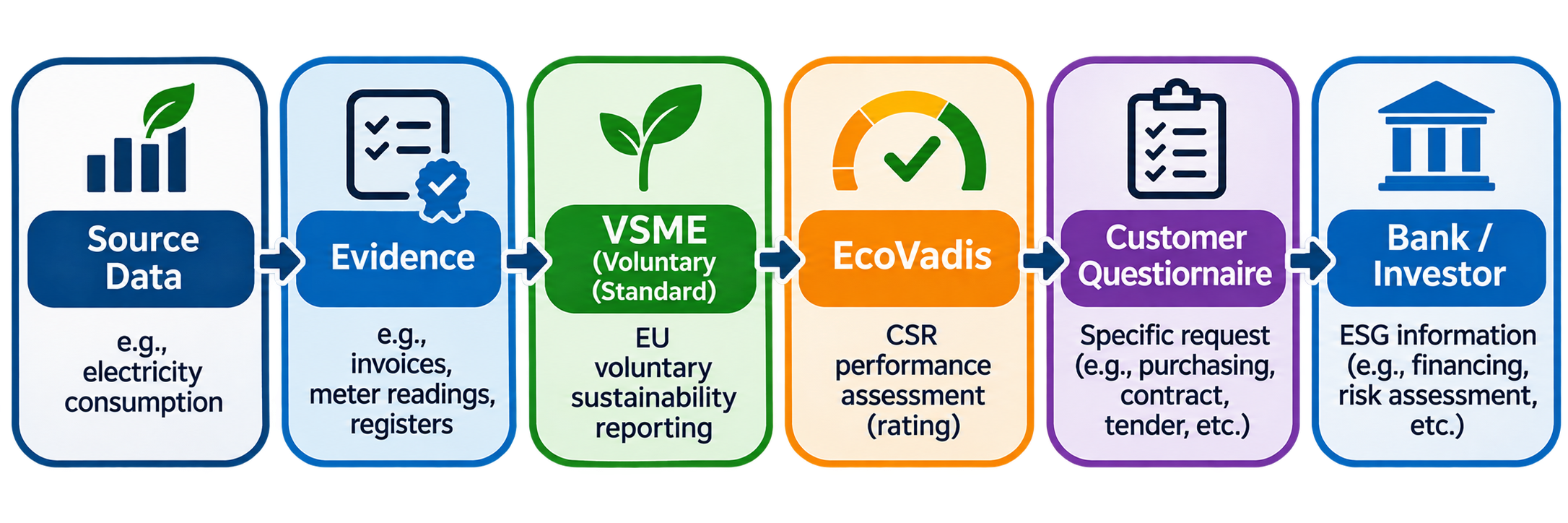
electricity consumption → source data → Scope 2 calculation → VS → customer questionnaire → reporting or evidence that can support an EcoVadis assessment
The objective for an SME is therefore not to create three separate systems.
It is to make the underlying information sufficiently reliable, traceable and reusable to support several outputs.
Should your SME implement the VS now?
Not necessarily. The value of the standard depends mainly on the requests your company needs to answer and on how your sustainability information is currently organised.
Start by looking at your own situation.
Case 1: You receive very few sustainability information requests
Start by monitoring the requests you actually receive.
There is probably no need to build a complete system immediately simply because the VS exists.
Your first objective may be to identify which types of information are becoming recurrent.
Case 2: Several customers regularly request the same information
The VS can become a useful reference for structuring a shared information base.
Instead of repeatedly searching for the same energy consumption figure, workforce figure or policy, the company can progressively define:
data → data owner → source → supporting evidence → update frequency → external uses.
Case 3: You are preparing for an EcoVadis assessment
This case has become particularly relevant since EcoVadis published its methodology update on 14 October 2026.
EcoVadis updated its terminology from VSME to Voluntary Standard (VS/VSME) and introduced standardised reporting metrics aligned with frameworks including the VS, the European Sustainability Reporting Standards (ESRS), the Global Reporting Initiative (GRI) and standards issued by the International Sustainability Standards Board (ISSB).
EcoVadis also indicates that reporting aligned with the VS/VSME Basic Module, or with both the Basic and Comprehensive Modules, can be recognised in its reporting assessment.
The VS therefore does not replace EcoVadis.
But the relationship between the two frameworks is now more direct than before.
For an SME, this strengthens the case for building a single sustainability data and evidence base that can be reused across several contexts instead of preparing separately for:
- the VS;
- EcoVadis;
- each customer questionnaire.
Eco Fluent Solutions – observation
As sustainability frameworks increasingly converge around certain types of information, the right response is less about creating more files. The priority becomes the quality of the underlying information base: consistent data, identified owners, available evidence and clear update rules.
Case 4: Banks or investors are requesting more ESG information
Responding to information needs from banks and investors is explicitly one of the objectives of the European Voluntary Standard.
The VS can therefore provide a common structure where those requests become recurrent.
However, it does not guarantee that a bank or investor will limit its request strictly to the standard. Its own risk assessment or internal policies may require additional information.
Case 5: You want to structure your sustainability approach without creating a heavy system
The Basic Module can provide a proportionate starting point.
The immediate objective does not have to be a sophisticated sustainability report.
An SME can first use the standard to identify:
- information it already has;
- internal data owners;
- available source documents;
- supporting evidence;
- missing data;
- information requiring regular updates.
In that sense, the VS becomes less a reporting exercise and more a framework for progressively organising the company’s sustainability information.
Where should an SME start?
Before completing every field in Portail RSE, I recommend five steps.
1. Inventory your existing requests
Bring together:
- customer questionnaires;
- EcoVadis requests;
- tender requirements;
- bank requests;
- carbon-related requests.
2. Identify recurring data
Which information is being requested repeatedly?
3. Identify the data owner
Who actually owns each item?
Finance? HR? QHSE? Procurement? Management?
4. Connect each datapoint to evidence
Useful information should be traceable back to its source.
5. Then use the VS as a comparison framework
You can then distinguish:
- what already exists;
- what is poorly structured;
- what is genuinely missing;
- what is not relevant to your context.
The sequence matters.
Starting by creating new documents risks turning a proportionate standard into an unnecessarily heavy documentation exercise.
What I would avoid
Using an old VSME file without checking its date
The framework changed in 2026.
Assuming the VS is mandatory because it is established by a Regulation
The standard remains voluntary.
Assuming the value-chain cap eliminates all customer requests
It applies to a specific context: information requested for CSRD reporting purposes.
Using the VS only “for compliance”
For an SME outside mandatory CSRD reporting, the more useful question is whether the framework helps the business organise and reuse information.
Completing a report without organising the underlying source data
The report is only the output.
The real system sits behind it:
data → owner → source → evidence → control → update.
FAQ : VSME 2027 in France
Is the VSME mandatory in France in 2027?
No. The Voluntary Standard (VS/ex-VSME) remains voluntary for eligible undertakings. The EU Regulation itself provides that undertakings outside mandatory sustainability reporting may use it voluntarily.
What is the difference between the VSME and the VS?
The VSME developed by EFRAG and recommended by the European Commission in 2025 became the basis for the Voluntary Standard adopted in 2026. France’s Portail RSE now uses the wording VS (ex-VSME) to reflect this transition.
Is there a French version of the new standard?
Yes. Portail RSE already provides French-language resources and allows undertakings to work through the VS (ex-VSME) online. Its October 2026 public guidance states that it has been updated to reflect the new delegated act and the Omnibus Directive.
Does France need to transpose the VS?
No. Commission Delegated Regulation (EU) 2026/1560 is directly applicable in all Member States. However, Directive (EU) 2026/470 contains provisions that must be transposed into French law, mainly by 19 March 2027.
What is the value-chain cap?
It is a limit on the sustainability information that undertakings subject to the CSRD may request, for their own reporting obligations, from certain undertakings in their value chain that do not exceed 1,000 employees. The mechanism applies for financial years beginning on or after 1 January 2027.
Does the VS replace EcoVadis?
No. The two have different purposes. However, some of the same underlying sustainability data and supporting evidence can be used across both, making a reusable information base increasingly valuable.
Is the VS useful for a small SME?
It depends on the company’s needs. It can be particularly useful where several customers, finance providers or partners repeatedly request sustainability information, or where the company wants to structure its approach without adopting a disproportionate reporting system.
Should an SME start directly in Portail RSE?
Portail RSE is a useful practical tool. However, before completing every field, it is worth identifying your existing requests, available data and internal data owners so that the exercise does not become a simple documentation collection exercise.
About the author
Souha Bel Haj Messaoud, founder of Eco Fluent Solutions, works at the intersection of engineering, quality systems, sustainability and validation/verification.
For SMEs, Eco Fluent Solutions helps structure the sustainability information, supporting evidence and internal responsibilities needed to respond more effectively to customer requests, EcoVadis assessments and emerging sustainability data requirements.
The objective is not to create documents for the sake of documentation, but to build a simple, traceable and reusable system.
Author: Souha Bel Haj Messaoud – Eco Fluent Solutions
Unsure whether you need VSME, EcoVadis, a customer questionnaire response or a broader sustainability system?
You may not need to start with another report.
During a 30-Minute RSE Diagnostic, we identify together:
- what is actually triggering your sustainability information requests;
- what information your company already has;
- where the main weakness lies;
- and what should be addressed first.
The purpose is not to provide a full audit or strategy free of charge in 30 minutes.
You leave with a clearer understanding of your situation and the most useful next step.
Book my 30-Minute RSE Diagnostic
Sources and references
- European Union – Commission Delegated Regulation (EU) 2026/1560 of 3 July 2026, published in the Official Journal of the European Union on 21 September 2026.
Establishes the Voluntary Sustainability Reporting Standard and the value-chain cap. - European Union – Directive (EU) 2026/470 of 24 February 2026, published in the Official Journal of the European Union on 26 February 2026.
Main transposition deadline: 19 March 2027. - Direction générale du Trésor – “Normes ESRS révisées : la Commission européenne publie les nouveaux standards de reporting de durabilité”, 21 October 2026.
- Portail RSE – “VS (ex-VSME) : comprendre la norme volontaire pour les PME”, 21 October 2026.
- Portail RSE – “Norme volontaire de durabilité – VS (ex-VSME)”, version consulted November 2026.
- Portail RSE – “Comment accéder aux standards VS (ex-VSME) traduits en français ?”, 2 September 2026.